CategoryParents

Mindfulness Program for Students

Mindfulness is a practice that has been gaining more and more attention in recent years, and is now being recognized as an important tool for young adults to unlock their potential and develop emotional intelligence. In this post we examine the importance of mindfulness for students, how it helps them, and outline the benefits, activities, and outcomes of our 6 Weeks to Self Mastery for Students program.

Mindfulness for Young Adults: Unlocking Potential and Developing Emotional Intelligence

Mindfulness is a way of being present in the moment, and can help young adults become more aware of their thoughts and feelings. It can help them to manage stress and anxiety, and to develop a greater sense of self-awareness and emotional intelligence. Mindfulness can also help students to develop better relationships, communication skills, and problem-solving abilities.

people giving high fives
Photo by Yan Krukov on Pexels.com

How Mindfulness Helps?

Mindfulness helps young adults to better understand their emotions and how to respond to them in a healthy way. It can help them to develop better coping skills and to increase their focus and concentration. It can also help them to become more self-aware, and to better recognize their personal strengths and weaknesses.

6 Weeks to Self Mastery

6 Weeks to Self Mastery series for middle and high school students starts in January! What’s it all about?

The program includes a series of classes and activities that focus on teaching young adults the principles of self mastery through mindfulness. The classes include breathing exercises, yoga, sound therapy, and mindfulness activities such as conscious games, guided discussions, how to journal, and reflective practices.

These activities are designed to help young adults to become more aware of their thoughts, feelings, and emotions and how to respond to them in a healthy way.

Mindfulness with high school students

Outcomes: The program is designed to help young adults to better recognize their personal strengths and weaknesses, to gain greater insight into their thoughts and feelings, and to develop better self-awareness and emotional intelligence. It can also help them to learn better coping skills, to reduce stress and anxiety, and to develop better relationships, communication skills, and problem-solving abilities.

Conclusion: Mindfulness is an important tool for young adults to unlock their potential and develop emotional intelligence. Our mindfulness program can help students to become more mindful and aware of their thoughts and feelings, and to develop better coping skills, stress reduction, and problem-solving abilities.

6 Weeks to Self Mastery

Help your teen/young adult reach their full potential!
For students in the Palm Beach area (North Palm Beach, Palm Beach Gardens, Juno Beach, Jupiter)

Mindful Minutes – Powerful Visualization Practice to Center Your Mind

In today’s mindful minutes we jump right in and complete the practice with a color visualization to center the mind and strengthen our ability to picture our goals.

Get the Transformational Mindfulness book here: https://jah.life/product/transformati…

Or on Amazon: https://a.co/d/d8gYa8T

Mindful Minutes – Reset Your Mind In Less Than 10 Minutes

In this episode of mindful minutes we jump right in with a mindful presence exercise. Get present and refresh your state of mind in less than 10 minutes with this practice. Manage anger, stress, frustration, lack of motivation, and direct your energy to reaching your full potential!

Mindful Minutes – How to Use Singing Bowls For A Mindfulness Practice

In today’s mindful minutes, we talk about singing bowls. Sounds are extremely therapeutic and can be used for anything from mindfulness to cancer treatments!

treatments! Learn more about sound at https://Easternvibration.com

Subscribe & Follow

Expand your consciousness with JAH Advisory Updates and discover health, wealth, & happiness!
Sign up to our newsletter for the latest updates!

and
Connect with us on social media.

This is What it Takes to Be Self Motivated – Even Through Depression

Self motivation is one of the 5 key components of emotional intelligence (EQ). It is the ability to work towards an immaterial goal, usually with no definite end. It also helps with depression and other mental health challenges. When we are self motivated, we get many benefits with it, such as increased confidence which affects all aspects of our lives. Developing emotional intelligence is a great way to build mental resilience.

How do we motivate ourselves?

We motivate ourselves by being mindful and disciplined. A mindfulness practice helps us to stay in the present moment and enjoy the process of whatever we are doing. It also helps us to recognize our needs and recognize our passions – what is truly fulfilling to us. When we focus on the things that we want out of life, it’s easier to be naturally motivated.

Remember to focus on the things you do want out of life and enjoy the process.

Discipline is also motivating when it comes from a place of self-love. For example maintaining a healthy diet or exercising regularly is a way to show ourselves self-love and these are both processes that are continuously ongoing. They don’t have a finite end. If you want to be healthy then we have to continue to exercise and eat healthy; we can’t just say “I’ve ran enough miles, I think I’m healthy” and be done with it forever. By being disciplined in our actions, we can be immersed in them and truly enjoy the process, rather than focused on the goal(s) or circumstances.

Self regulation, another component of emotional intelligence is also related to self-motivation. We have to regulate ourselves in order to be disciplined and present. We must be able to control our impulses and ultimately focus our attention on what is really fulfilling to us.

No action, no change

Practice, practice, practice!

Ultimately we must practice to train new habits. Practicing discipline or enjoying the process are habits to be practiced just like any other. If we want a strong mind, we have to train it. It may be difficult at first, but it gets easier with practice. Remember to focus on the things you do want out of life and enjoy the process. Think of everything as a learning experience. Also consider a continuous or immaterial goal. If that seems too abstract, think of something that you can work on that doesn’t have an end – it is ongoing.

Mindful Minutes – Breathing with Intention

In this episode of mindful minutes we do a mindful breathing exercise from the Transformational Mindfulness book. We learn the proper way to breathe and the benefits of healthy breathing habits. Get the book at our store here: https://jah.life

Subscribe & Follow

Expand your consciousness with JAH Advisory Updates and discover health, wealth, & happiness!
Sign up to our newsletter for the latest updates!

and
Connect with us on social media.

Finding The Time For Wellness At Work

Often times we are busy. Too busy to relax it seems.

But that’s not true. That’s a narrative we give ourselves. There’s always time to take care of ourselves. Sometimes it may not seem like it, but there is. Especially on a busy work day – that’s when we may need a moment of mindfulness the most. And it doesn’t take much! Read on to learn one of our mindfulness exercises for workplace wellness.

If you have ever had brain fog, decision fatigue (when someone asks you any question, and it feels frustrating), or felt short tempered after a long day, then you can understand how constant stress and stimulation affect us. We are not designed to grind for 8+ hours, jumping from one task, appointment, or event to another. We are meant to have cycles and periods of slowing down, to prepare the mind and body for action again when required.

Our health and particularly our stress levels play a huge role in performance and productivity. We function at our best when we are able to pause and reset throughout the day. For most people, productivity falls after about 2 hours of working. After that it is best to take a break. Practicing mindfulness helps us to increase our emotional intelligence (eq) recognize our current state of being so we can adjust accordingly. Wellness at work is extremely important and it begins with managing our stress and emotions. There are many factors to employee health, but for us it starts with the mind body connection.

When you start to notice those symptoms of stress and fatigue, it’s time to check in with yourself.

A Quick Check-In

Here is a short version of a mindfulness exercise from our employee wellness programs. This can be done in as little as 2 minutes. And helps you to recognize where you are at and if you want to shift your mindset at all.

  1. Sit comfortably with a straight back and shoulders relaxed.
  2. Close your eyes.
  3. Think of 1 word that describes how you feel right now, in the moment.
  4. Take 3 deep breath in through the nose and out through the mouth.
  5. Continue breathing through the nose if possible.
  6. Observe the breath; notice the expansion/contraction of the lungs and belly with each inhale/exhale.
  7. Set an intention – Gratitude and presence, or anything you want to make a part of your subconscious action.
  8. Bring the attention back to the rhythm of the breath.
  9. Think of 1 word that describes how you feel right now, in the moment.
  10. Blink the eyes open (Optionally: Cup the hands over the eyes before opening).

We Are Here For You

JAH Advisory offers workplace wellness programs with self-mastery in mind. Starting with mindfulness and emotional intelligence, we teach how each individual can reach their highest potential. With these practices we can be more accountable, more focused, and more fulfilled! Health is wealth, and it shows! Companies can save millions by investing in employee wellness. Learn more about the benefits and schedule a call here:

Mental Health Awareness and Screening for Depression

I’m writing this post because in the last week we had depression screening day and mental health awareness day. October is mental health awareness month. However, throughout the year it feels like every day is some kind of focused awareness event, and quite honestly, I can’t keep up. Perhaps it’s just that technology is making all these events easier to document and track or maybe its my involvement in the community expanding my awareness. But the fact remains, it can feel overwhelming sometimes – jumping from one topic to the next – leaving me to wonder if it’s really effective or if we are just constantly going from one to the next, too busy keeping up to absorb the meaning of the day. These days can be good for awareness, but not so much for individuals.

Often times we see the quote “Mental health is health”, which is true, but also health is health. Everything is connected. We need to break out of the silo mentality when it comes to mind body health. Gut health is mental health. Physical health is mental health. Eat healthy or go for a run and you will be in a better state of mind than otherwise. It takes balance to be healthy. We can’t to go to the gym, have a terrible diet, and then expect optimal performance – mental or physical.

Ups and downs are a natural part of life and they serve a purpose. No emotion is inherently good or bad.

Mental resilience, or a strong mind is important to have. For me it is a choice to identify with a disease vs. having a strong mind. Do I get depressed? Sure, I’m more susceptible than most people. Life is not perfect, but that’s a part of it. Sometimes I think it is all pointless. Things don’t always go according to plan. We experience pain. Relationships drift apart. We feel lost. Possessions are temporary. People die. People should be screened if they experience any of this and don’t feel a little depressed. I’m going to do you a favor and say you don’t need to go anywhere. Take a pause and check in with yourself. This is the best screening possible. You know if you feel happy or not – if you feel fulfilled or not, if you feel sad, or stressed, or overwhelmed. And if you’re not sure, then that means it’s time to take a pause and check in. Ultimately it’s up to us to be accountable for our health.

So what do we do? First off, lets not get ourselves more down about feeling down. It is common for us to intensify undesirable emotions because we are so focused on them. We get so focused on our depression or anger that it makes us more depressed or angry! Ups and downs are a natural part of life and they serve a purpose. No emotion is inherently good or bad. Once we accept, that, we can use our emotions to our advantage. For example, feel down/depressed allows for greater introspection – to look within and re-evaluate our needs/actions.

  1. Take inventory
    • Take note of one word describing how you feel right now.
    • (Optional) Do a stress inventory. Stress is the top contributing factor for most chronic disease, immunity, mental health imbalances, and overall well-being. Sometimes we don’t recognize how much stress we are experiencing. This can help to put what we are experiencing in life into perspective.
  2. Practice mindfulness! Gratitude and positivity are two easy exercises. Remember that the mind is a muscle. The more we practice positive thinking, the easier it becomes. When we practice mindfulness it also increases our emotional intelligence and stress management skills.
    • Note down 3 things you are grateful for.
    • Practice re-framing negative thoughts into positive ones. Gratitude and humor are 2 easy ways to do this.
  3. Exercise – This is talked about all the time so I won’t go into too much detail here. Something as little as going for a walk can make a huge difference in how you feel. Do what feels good – yoga, calisthenics, cardio, weights – it all helps to get more blood flowing which means more oxygen and nutrients for the brain and body.
  4. Eat Healthy – Diet is huge but not for the reasons you might think. Yes, you want healthy toxin-free building blocks to support a healthy brain and body. But more importantly the gut produces most of our “happy molecules”, the hormones and neurotransmitters that help us to regulate our emotions and feel good. The gut really is the 2nd brain (or the 1st brain according to some people!)
  5. Find your passion – If you feel like you are not reaching your full potential or unfulfilled in any capacity, on a day to day basis then it means you are not putting energy towards things that make you happy. Find a hobby, join a club, build relationships – do what you need to do to feel fulfilled.

Self-Care Sunday: Taking Time To Nurture Yourself

Have you taken the time to nurture yourself this week? Let’s be honest, in the hustle and bustle of life we tend to leave ourselves behind from time to time. It’s easy to put work, kids, deadlines and family needs before our own. Eventually this leads to burnt out, leaving us tired and empty.

That’s why it’s essential that we tend to our own needs and mental health. Otherwise, we will be pouring ourselves out of an empty vessel. Hence, the title. 

Let’s do a little check-in. Below are some questions to start with: 

  • What is the first thing you do when you wake up?
  • Do you have a morning routine? A ritual?
  • Practical steps that can set up your day for the best possible outcome? 

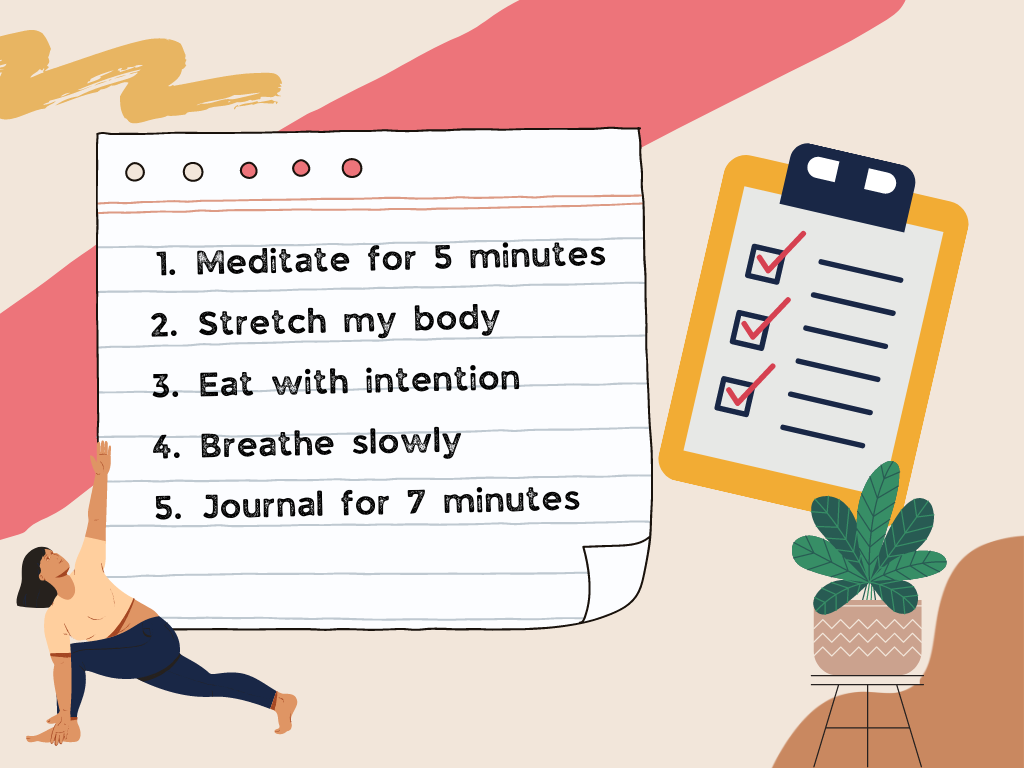
Here are few simple things I do first thing in the morning to make sure I am setting myself up to win:

  • State a positive affirmation (while still in bed)
  • Light stretch
  • Brush my teeth
  • Take a shower
  • Meditate
  • Light yoga (while the coffee is brewing) 
  • Journal ( it doesn’t have to make sense) 

Yes, seriously. I do all of these things within the first two hours upon waking, either before heading to work or getting my day started with my family. 

You’d be surprised at how these common sense and simple things are overlooked and undervalued. 

Choose one, two or all of them and try it on. Simply spend a few minutes on each and see how you feel. 

Take inventory before you go to bed. What worked? What didn’t work? And what can you do differently tomorrow?

Don’t overthink it. It takes daily practice, consistency and a little willingness.  

Trust the process.