Tagmeditation

9 Awesome Facts That Will Boost Your Respect for Plants

Plants are integral to life. They do so much more than provide us with oxygen! In this article we will take a look at how plants can help us to practice mindfulness. In a world where people spend more and more of their time indoors working on computers or attending meetings (or attending meetings on their computers), it’s important to create an environment that is conducive to good health and productivity. One way to achieve this is by adding plants to your home and workplace. Let’s take a look at these 9 facts that everyone should know about plants!

1. They Purify the Air

We will start with the obvious one that comes to mind for most people. Indoor air pollution can be a real problem, especially in many workplaces. The chemicals released from furniture, carpets, paint and cleaning products can cause headaches and respiratory problems. Plants are natural air purifiers that absorb toxins like formaldehyde and benzene while releasing fresh oxygen into the air.

2. They Relieve Stress

The presence of greenery has been shown to reduce stress levels. Studies have found that simply looking at plants can lower blood pressure and heart rate while increasing feelings of calmness.

two pink and green orchid flowers
Photo by Anthony : ) on Pexels.com

3. They Boost Your Immune System

Plants release negative ions which reduce internal stress and strengthen the immune system. The humidity created by indoor plants also helps to prevent dry skin, colds, sore throats and dry coughs by keeping mucous membranes moist which makes them less susceptible to infection.

4. They Improve Your Mental Health

With the combination of benefits from reduced stress and increased oxygen, plants improve your mental health. A study done at Washington State University showed that when plants were added to workspaces there was a 70% reduction in sick leave due to depression or anxiety related illnesses over six months compared with those without plants.

5. They Improve Your Physical Health

The presence of indoor plants has also been linked with reducing eye strain, headaches and fatigue. The calming effects plants have on our nervous system help us feel less stressed and more energized throughout the day.

6. They Increase Your Productivity

It seems like everything about plants help us to create a mindful experience. Research has shown that the presence of plants in the workplace can increase productivity by up to 15%. This is because they help to reduce distractions and create a calmer, more relaxed environment which allows employees to focus on their work better.

woman using laptop
Photo by Jopwell on Pexels.com

7. Plants in the Workplace Can Improve Employee Satisfaction

In addition to improving health and productivity levels, adding plants to your workspace can also improve employee satisfaction. When employees feel good about their surroundings, they are more likely to be happy at work and stay with their company for longer periods of time. Keep plants in mind for your list of tools for reducing stress in the workplace.

8. Plants Are Alive and Constantly Communicating

Another benefit of having plants in your workspace is that they are alive! Not only do they communicate with each other, but plants are constantly sending out electrical and chemical signals. A part of this electrochemical communication is through changes in color or texture making them an interesting addition that adds life into any space! Plants even have the ability to teach each other how to make different types of signals – meaning plants can teach each other how to make different molecules. So respect plants and the environment, or they might start turning against us!

9. Plants Bring us Back to Nature (Or Bring Nature to Us)

Plants remind us of nature. This plays a huge part in regulating our nervous system. White lights, angled corners, and straight hallways of most buildings are inherently stressful. Most people have become accustomed to these things, but nature does not usually move in straight lines. Witnessing plants’ colors and unique shapes helps to break the monotony and eeriness of the man-made world. This is likely why they help to reduce stress and induce a feeling of calm.

green grass field
Photo by Baskin Creative Studios on Pexels.com
interior of hall and kitchen in office
Photo by Max Rahubovskiy on Pexels.com

Conclusion

a laptop and houseplants on a desk in an apartment

There we have it – 9 Reasons to pay more attention and respect to plants. They can improve any space and help to reduce stress, purify the air, increases productivity, and improves overall health and wellness. With all these benefits to be gained from adding plants to your home or workspace, consider adding some greenery!

How To Add Plants To Your Space

  • Choose how and where you want to place your plants (hanging, at the end of a hallway, integrated with other fixtures, etc)
  • Determine what kind of lighting you have available (natural light or artificial)
  • Select appropriate plants based on lighting conditions
  • Create a watering schedule
  • Add fertilizer as needed
  • Clean leaves regularly
  • Enjoy!

Subscribe & Follow

Expand your consciousness with JAH Advisory Updates and discover health, wealth, & happiness!
Sign up to our newsletter for the latest updates!

and
Connect with us on social media.

Mindful Minutes – 5 Minute Practice to Master Your Mind and Reach Your Goals

In this episode of mindful minutes we jump in with a powerful shamanic heartbeat and set our intentions on a subconscious level. Mindfulness minutes is your time to reset your mind and set your intentions for the day. This short mindfulness practice improves our emotional intelligence and ability to focus on our intentions. This is one of the greatest tools we have to unlock our potential.

Mindful Minutes – Powerful Visualization Practice to Center Your Mind

In today’s mindful minutes we jump right in and complete the practice with a color visualization to center the mind and strengthen our ability to picture our goals.

Get the Transformational Mindfulness book here: https://jah.life/product/transformati…

Or on Amazon: https://a.co/d/d8gYa8T

This is What it Takes to Be Self Motivated – Even Through Depression

Self motivation is one of the 5 key components of emotional intelligence (EQ). It is the ability to work towards an immaterial goal, usually with no definite end. It also helps with depression and other mental health challenges. When we are self motivated, we get many benefits with it, such as increased confidence which affects all aspects of our lives. Developing emotional intelligence is a great way to build mental resilience.

How do we motivate ourselves?

We motivate ourselves by being mindful and disciplined. A mindfulness practice helps us to stay in the present moment and enjoy the process of whatever we are doing. It also helps us to recognize our needs and recognize our passions – what is truly fulfilling to us. When we focus on the things that we want out of life, it’s easier to be naturally motivated.

Remember to focus on the things you do want out of life and enjoy the process.

Discipline is also motivating when it comes from a place of self-love. For example maintaining a healthy diet or exercising regularly is a way to show ourselves self-love and these are both processes that are continuously ongoing. They don’t have a finite end. If you want to be healthy then we have to continue to exercise and eat healthy; we can’t just say “I’ve ran enough miles, I think I’m healthy” and be done with it forever. By being disciplined in our actions, we can be immersed in them and truly enjoy the process, rather than focused on the goal(s) or circumstances.

Self regulation, another component of emotional intelligence is also related to self-motivation. We have to regulate ourselves in order to be disciplined and present. We must be able to control our impulses and ultimately focus our attention on what is really fulfilling to us.

No action, no change

Practice, practice, practice!

Ultimately we must practice to train new habits. Practicing discipline or enjoying the process are habits to be practiced just like any other. If we want a strong mind, we have to train it. It may be difficult at first, but it gets easier with practice. Remember to focus on the things you do want out of life and enjoy the process. Think of everything as a learning experience. Also consider a continuous or immaterial goal. If that seems too abstract, think of something that you can work on that doesn’t have an end – it is ongoing.

Self-Care Sunday: Taking Time To Nurture Yourself

Have you taken the time to nurture yourself this week? Let’s be honest, in the hustle and bustle of life we tend to leave ourselves behind from time to time. It’s easy to put work, kids, deadlines and family needs before our own. Eventually this leads to burnt out, leaving us tired and empty.

That’s why it’s essential that we tend to our own needs and mental health. Otherwise, we will be pouring ourselves out of an empty vessel. Hence, the title. 

Let’s do a little check-in. Below are some questions to start with: 

  • What is the first thing you do when you wake up?
  • Do you have a morning routine? A ritual?
  • Practical steps that can set up your day for the best possible outcome? 

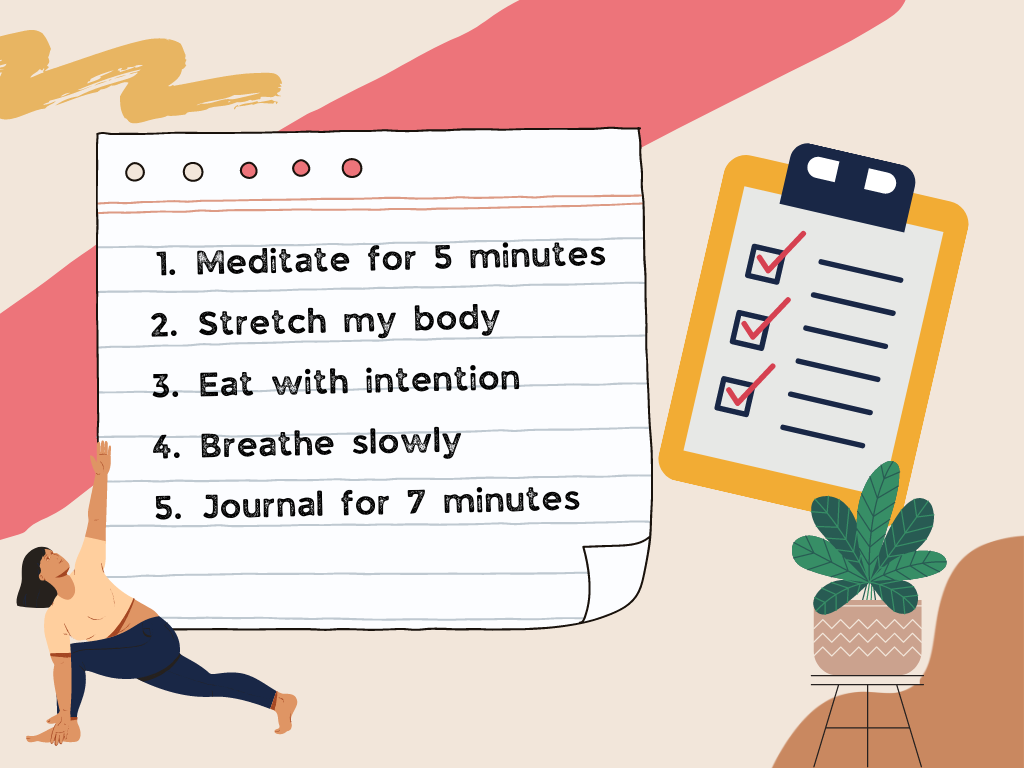
Here are few simple things I do first thing in the morning to make sure I am setting myself up to win:

  • State a positive affirmation (while still in bed)
  • Light stretch
  • Brush my teeth
  • Take a shower
  • Meditate
  • Light yoga (while the coffee is brewing) 
  • Journal ( it doesn’t have to make sense) 

Yes, seriously. I do all of these things within the first two hours upon waking, either before heading to work or getting my day started with my family. 

You’d be surprised at how these common sense and simple things are overlooked and undervalued. 

Choose one, two or all of them and try it on. Simply spend a few minutes on each and see how you feel. 

Take inventory before you go to bed. What worked? What didn’t work? And what can you do differently tomorrow?

Don’t overthink it. It takes daily practice, consistency and a little willingness.  

Trust the process.

Practicing Mindfulness With Family

Practicing mindfulness has many benefits for all areas of life. It affects physical, emotional, mental, and social well-being. It’s an even more powerful tool when that intention and awareness is shared with others – in this case, our family. A Family that practices mindfulness together, stays together.

A mindful family is:

  • Aware of each other’s wants/needs
  • Emotionally available
  • More likely to take responsibility for how we are feeling
  • Less likely to project negative feelings onto others

Cultivate Curiosity

Mindfulness can be a new and odd subject to those who are unfamiliar. To avoid awkward interactions like in the comic, we want to introduce mindfulness in a way that instills curiosity. Questions that may get others to be curious about mindfulness are:

  • Are you present?
  • How do you feel right now? Do you want to change anything about that?
  • Have you set an intention (for the day/activity)?
  • What do you think of taking a few minutes to be mindful with ourselves and each other?

Starting a Practice

A family that practices mindfulness together, stays together.

Start Small – try a short mindfulness minutes activity and reflect on the experience as a group (perhaps before/after a meal). Most of our mindfulness activities include the following steps which can be used as a basis for your own activity!

  1. Close your eyes. Take 3 deep breaths in through the nose and out through the mouth.
  2. Name an emotion – what word best describes how you feel right now? Take note of it and let it go for now.
  3. Observe the senses (can be just 1 sense: i.e. Listen to the sounds around; or engage each of the senses if time allows: hearing, smell, taste, touch, sight).
  4. Observe the breath – Let it happen naturally without thinking about it.
  5. Set an intention. If nothing specific comes to mind, set an intention to be present and express gratitude throughout the day. The more you are specific about your intentions, the more likely you are to act on them without even thinking about it. We subconsciously achieve our goals or desired state of being.
  6. Name an emotion – what word best describes how you feel right now? Take note of it. Open your eyes.

Discuss your experience with your family. Here are possible discussion questions to get you started.

  • How do you feel? Do you want to change that? Remember we can hold on to, or let go of any emotion. It’s a choice.
  • Especially with family, be accountable for your own emotions. Don’t use crutches or deflections such as “I feel like you…”, or “You made me feel…” Own your feelings.
  • What are you working on?
  • Do you need support?

Try this activity with your kids, parents, spouse, or close friends. It is a great way to connect and share perspectives.

Be Yourself

Here I’ll share a little bit of a personal story.

Halloween is around the corner and because irony is one of my more favored humors, I wanted to leave everyone a positive reminder; wearing masks is fun, but being yourself is best.

But as I am writing this, I came across an interesting tidbit. October 29th is international internet day. I find this fitting because the internet is a symbol of communication and expression. The internet up many new channels of communication and expression. It gives us the ability to wear infinite masks. It also shows us how interconnected everything really is. We can open up portals to speak with and see friends and family from across the planet. Or we can communicate anonymously with millions of people. We can access information stored from incredible distances and carry it in our pockets. So I guess the other message for this post is let’s remember not to take the internet for granted and most of what we see online is a mask.

Some people worry about being judged by others, some people judge themselves too much. I fall into the latter category. As a child it bothered me that I would not be accepted into schools because of my hair – and when I did, I would be teased and get into fights with other children. It took a while for it to even occur to me to change myself for acceptance (which I tried and felt miserable).

You have to accept yourself before others can.

I’m more of the person to always ask “why?”. I accepted being different and stopped caring what other people think. Instead, I cared more about what I think, and set high standards upon myself. There’s nothing wrong with this but it’s important to remember not to judge yourself too harshly. Above all else, you have to accept yourself before others can.

We may want to be accepted into a certain circle, or simply appear a certain way to others. There are many reasons for wanting to wear a mask. Some believe that we are always wearing a mask. Regardless, we know what comes naturally and comfortably for us. This would be our “default mask” and nothing is better than this one. If it is a mask, it is one that does not create stress for us when we wear it, rather we find joy in being and expressing ourselves. Be yourself. Love yourself.

So yes, of course that means you can still be yourself AND dress up for Halloween.

Blessings,
Jahmaal

6 Minutes of Mindfulness